Tuesday, 22 March 2011

A Disease of Poverty: Dengue Fever

Dengue fever is a tropical disease caused by the dengue virus. It is a communicative disease and is also known as 'breakbone fever'. Symptoms of it include fever, skin rash, muscle and joint pains, and headaches. Dengue is often transmitted by a strain of mosquitoes, it is then also very rarely passed from person to person, and by vertical transmission (mother to offspring), in Singapore the disease is endemic, and organ transplants and blood tranfusions carry a risk of dengue fever transmission.
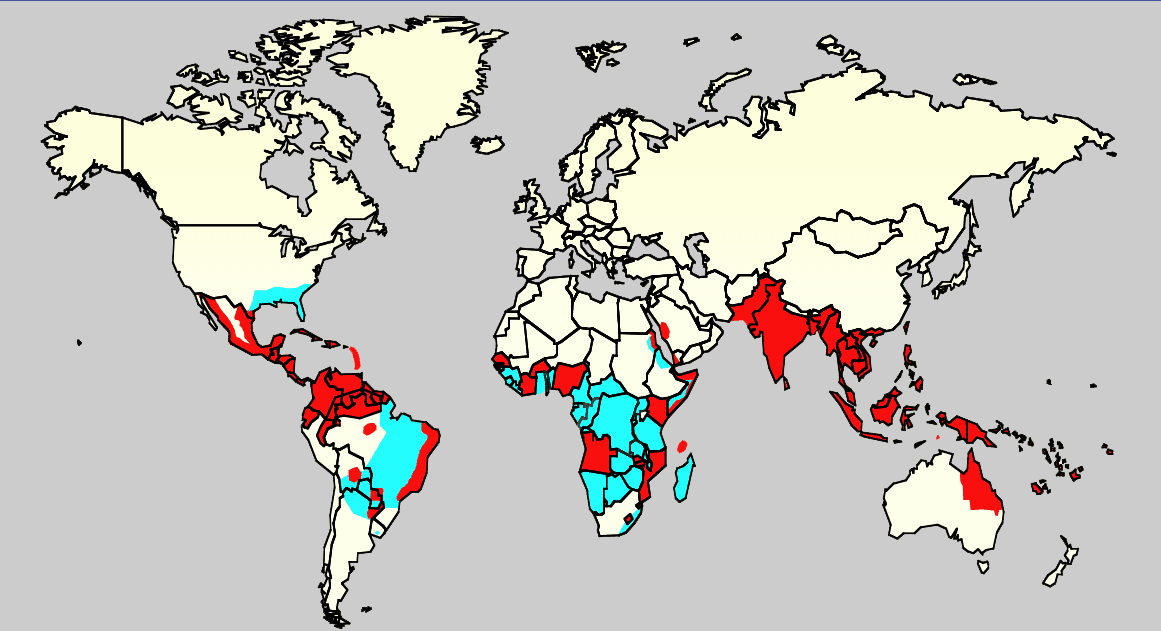
File:Dengue06.png
As you can see from the above map, red denotes a country or region with a dengue fever epidemic, and the azure shows a country with a more minor problem. Clearly, the virus is far more prevalent in the southern hemisphere, where climate is warmer and more humid and mosquitoes thrive. Also, most of the areas with high rates of disease are relatively poor, or have high rates of depravity. Clearly, sub-saharan Africa is rife with the ailment, where health care is poor and medication scarse, and India has a high rate of it, where the dense population and high humidity promotes the spread of the infection. In southern USA resides probably the clearest anomaly, however the hot temperatures and high numbers of immigrants from the southern and central Americas with little money to access health care will probably have lead to the disease being in this area.
The disease currently has no known vaccines, hence to control the disease there has been attempts at killing off the mosquitoes that transmit it, and controlling their areas. The best advice given is just to avoid being bitten. There is a mortality rate of one in ten of all people who get the disease. Usually as treatment sufferers are told to take many fluids, and some are given them intravenously. Ibuprofen and all risky methods are avoided as bleeding can be highly fatal when infected.

Friday, 18 March 2011

Thailand 100% Condom Programme

The commercial sex trade in Thailand really was the cause for HIV to spread throughout the country. The first case was diagnosed there in 1984, three years after HIV hit the headlines in the MEDW. The virus spread rapidly from there, men who had the virus would then give it to their wives, and then onto the children, and would often blame visiting a brothel for them having the virus. The Thai government decided this could not go on and so sent officials to the brothels to get the 'ladies' within tested for HIV. By 1990 30% of all prostitutes tested had the virus.

The Thai government decided that although there are laws against prostitution they deemed it safer to promote safer sex, as it is hard enough to change peoples actions, let alone stop those actions and change their morals. They offered 60million condoms nationally to all brothels so that no brothel would feel like it were losing custom by requiring a condom for sex, and led hard hitting TV and radio propaganda talking of all commercial sexual exchanges to be conducted with a condom.

It was an incredibly effective program. Within 5 years, the percentage of commercial sex acts where condoms were used increased from 15% to over 90%, and the number of men coming in with STDs decreased enormously. The quickly spreading HIV epidemic was largely brought under control. Although the 100% condom program couldn't eliminate all HIV transmission, in its early years it was one of the most effective government-instituted HIV control programs in history.

However, as the condom programme was aimed at commercial sex workers, it never really entered the public eye, as a result most new cases of HIV nowadays are in married women.

Essentially this is like the UK needle exchange, where drug users can exchange their dirty needles or syringes at the back door of most pharmacies in exchange for clean ones to prevent the spread of HIV. This is a lesson the MEDW is havaing to learn, just because you make something illegal, it does not mean that it will stop happening, as a result regulation and safety measures in illegal activities is making a more effective battle against HIV.